| |
| ISLANDS A-Z | CRETE | CYCLADES | DODECANESE | EASTERN AEGEAN |
| IONIAN | SARONIC | SPORADES | MAINLAND | ABOUT US |
Niokastro and the aqueduct in Pylos |
 |
|
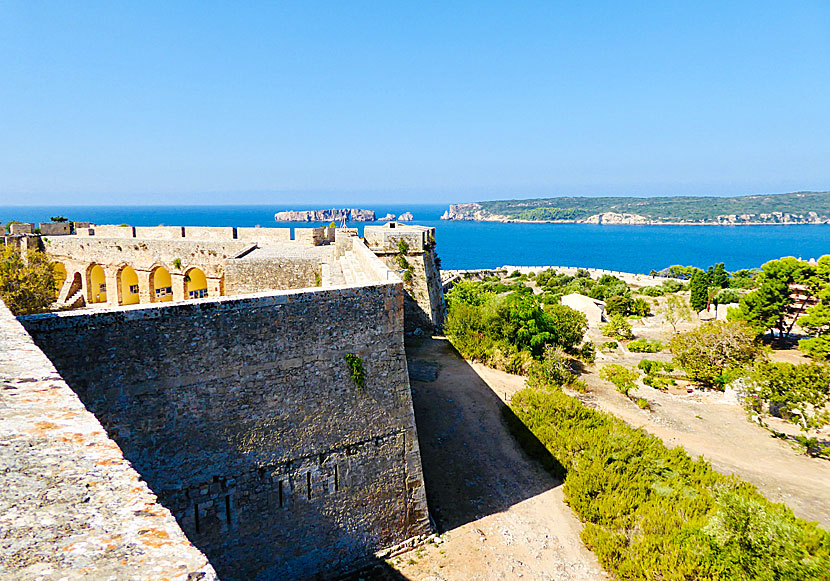
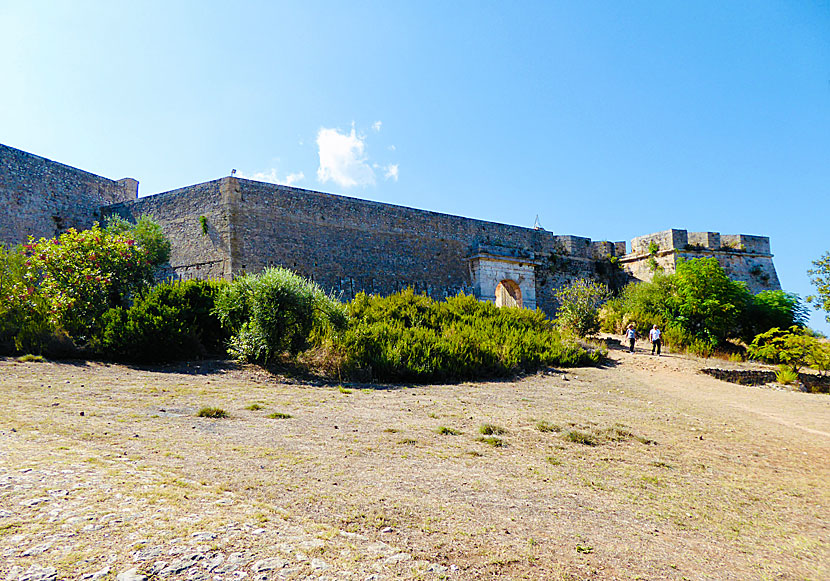
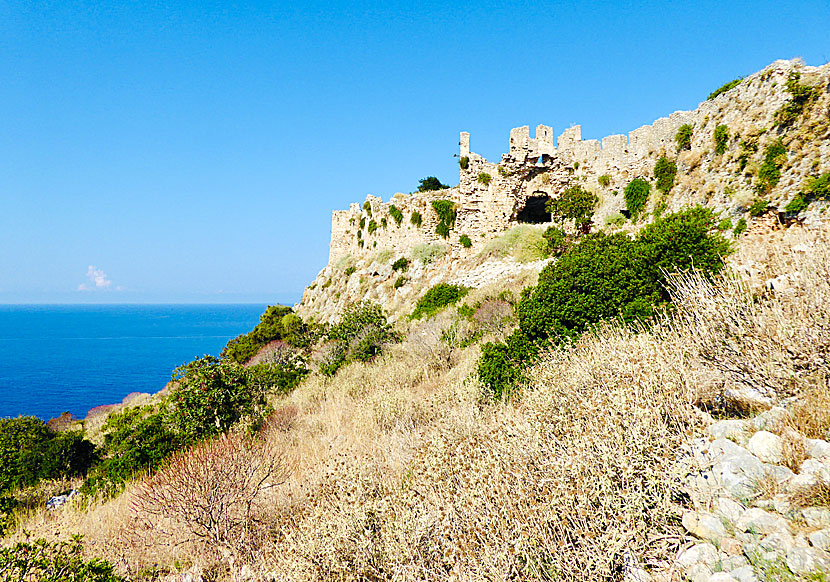
Niokastro in Pylos is said to be one of the best preserved fortresses in all of Greece. I will leave that to be seen. However, there is no doubt that it is well preserved, nor that the fortress is large, not to say gigantic.
Part of the inner fortress on the left and part of the outer fortress on the right.
Niokastro is also called Neokastro, Niokastro New Navarino and New Castle of Pylos. The prefix “new” is used because there is also an “old” fortress. It is called Paleokastro (paleo means old in Greek) and is also located in the Navarino Bay, diagonally opposite Niokastro. In Messinia, there are two other very well-preserved and interesting fortresses, namely Koroni Castle and Methoni Castle.
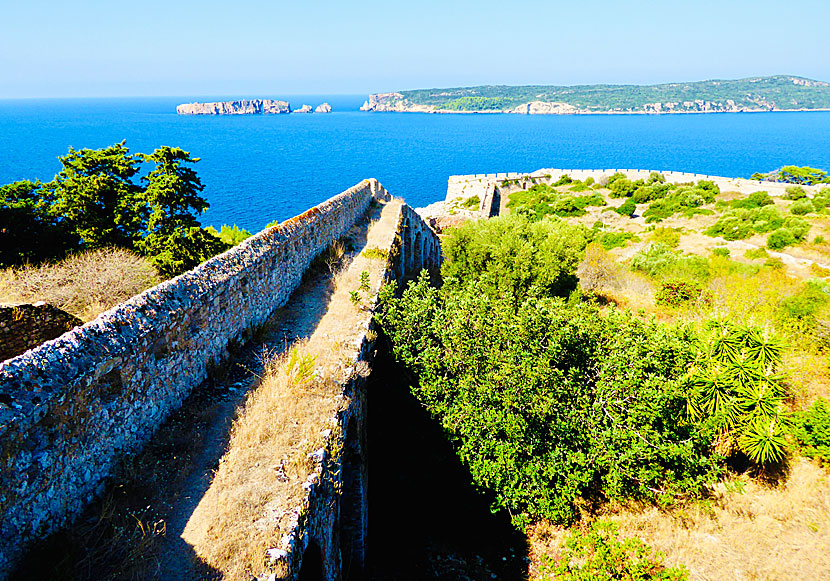
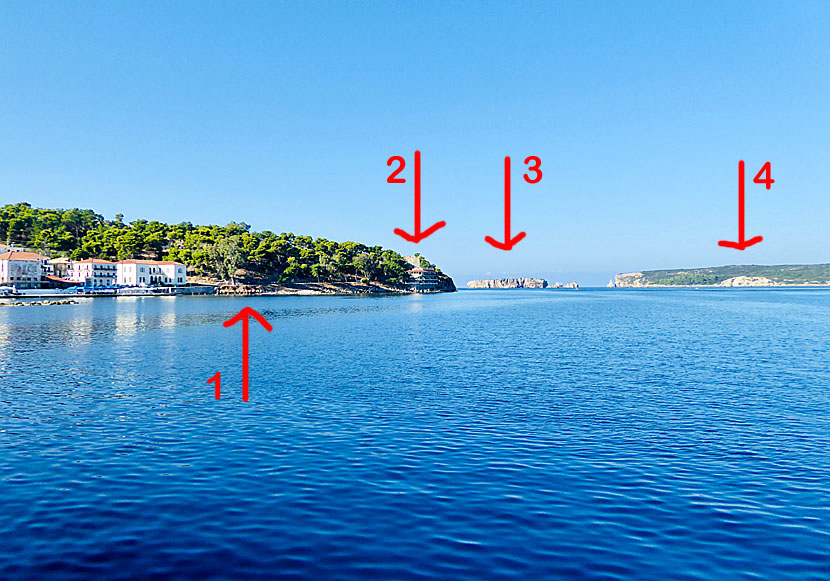
Part of the outer defensive wall and the islands of Fanari island and Sfaktiria island.
Niokastro was built in 1573 by the Ottomans, shortly after the Battle of Lepanto. The purpose was to control the entrance to the Bay of Navarino, one of the best natural harbors in the Mediterranean. The fortress was given thick walls, bastions and a well-protected harbor below. It became an important pawn in the power game between the Ottomans and Venetians, and later also the French and Greeks.
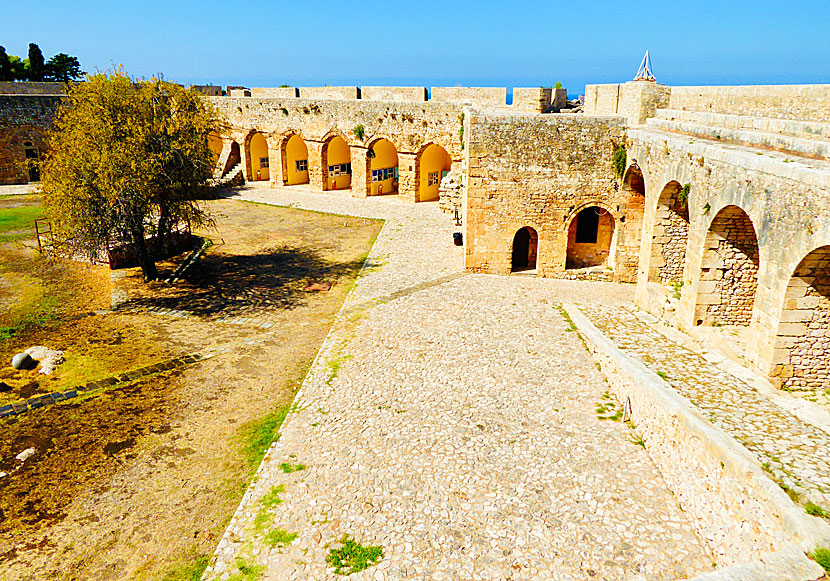
Part of the inner defensive wall of Niokastro.
During the 17th and 18th centuries, Niokastro changed hands frequently. Venetian troops captured the fortress during their campaigns, and the Ottomans retook it time and again. During the Greek War of Independence in the 1820s, Niokastro became a central location for the fighting, and after the decisive Battle of Navarino in 1827, the fortress finally became Greek. After 1830, Niokastro was used as a prison until 1941. During World War II, it was used as the headquarters of the Italian and later the German forces.
Read about the Battle of Navarino here »
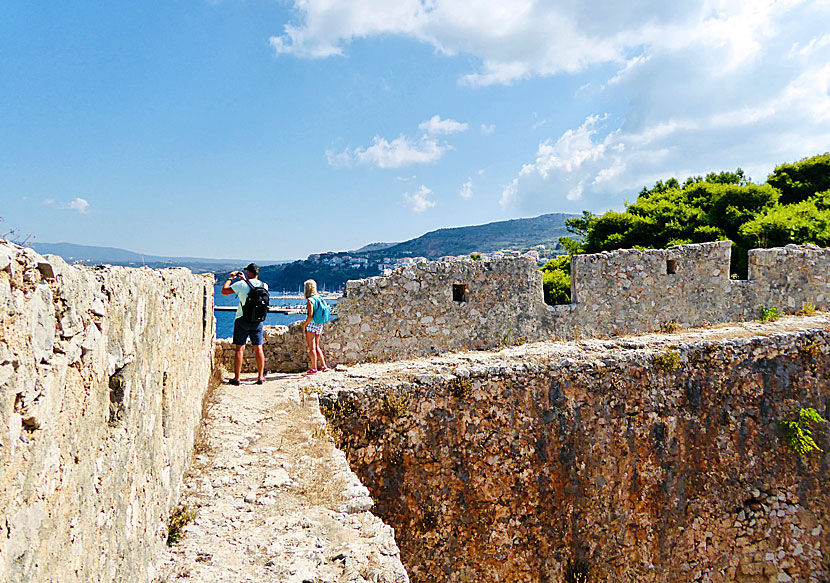
Pylos seen from the outer defensive wall of Niokastro.
Read about the wonderful village of Pylos here »
Niokastro was strategically located and was difficult to capture, and to discover, unless you came from the sea. Even today the fortress is almost invisible from land. If you did not know that Niokastro is where it is, you would not see it, despite its enormous size. Pylos was at that time a small village next to the large fortress of Niokastro. Pylos of today began to be built as late as 1828, the year after the Battle of Navarino. Niokastro is located within easy walking distance just west of the small beach in Pylos.
From left to right: 1 Pylos beach, 2 Nikokastro, 3 Fanari island och 4 Sfaktiria island. |
|
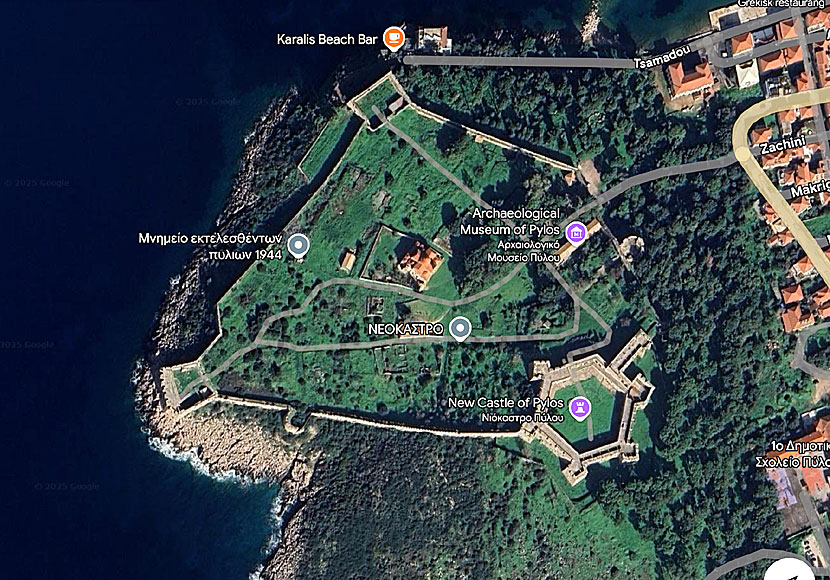
Niokastro consists of an inner and an outer courtyard. The outer castle is built of limestone blocks, with sloping walls and turrets. This is the part you first get to know. The defensive wall of the outer castle is in good condition and you can walk along the wall and enjoy the beautiful views over the Navarino Bay and the islands of Fanari and Sfaktiria.
In this picture from Google Maps you see the outer and inner courtyard.
Part of the inner courtyard.
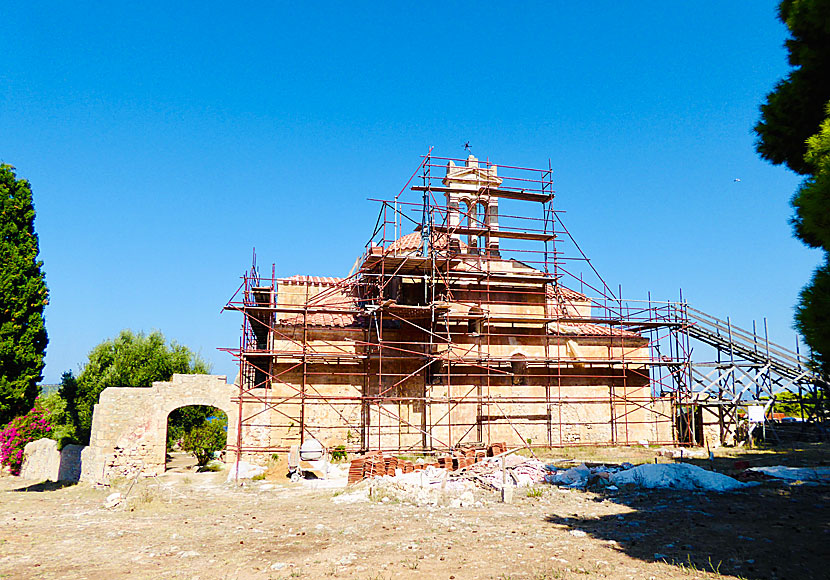
There are few buildings left in the outer courtyard. One of these buildings is the church with the long name The Church of the Transfiguration (Metamorphosis) of the Saviour. The church was first built as a mosque by the Ottomans, but was later converted by the Venetians into a Christian church, then back to a mosque, and finally ended up as a church. When I was here, the church was being renovated. I do not know if it has been completely restored. The other well-preserved building houses the Pylos Archaeological Museum.
The Church of the Transfiguration of the Saviour is located in the inner courtyard.
Niokastro Museum, or The Archaeological Museum of Pylos. |
|
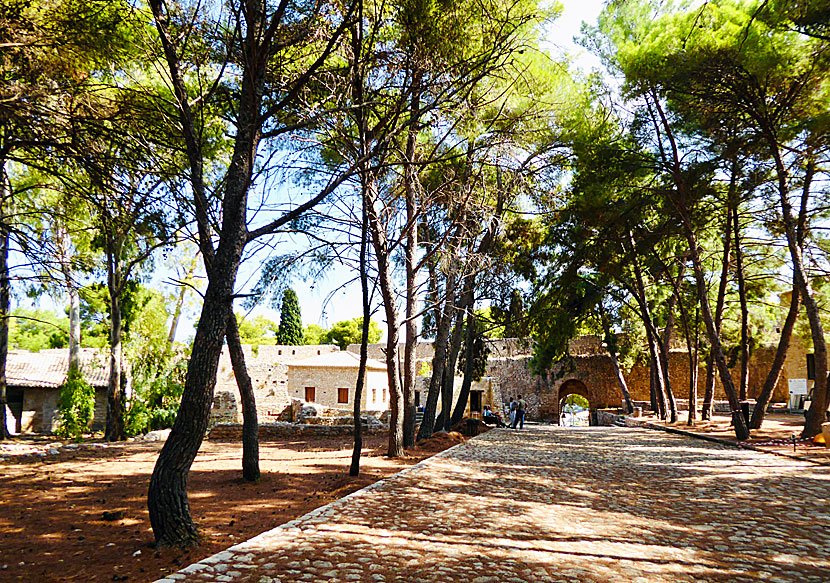
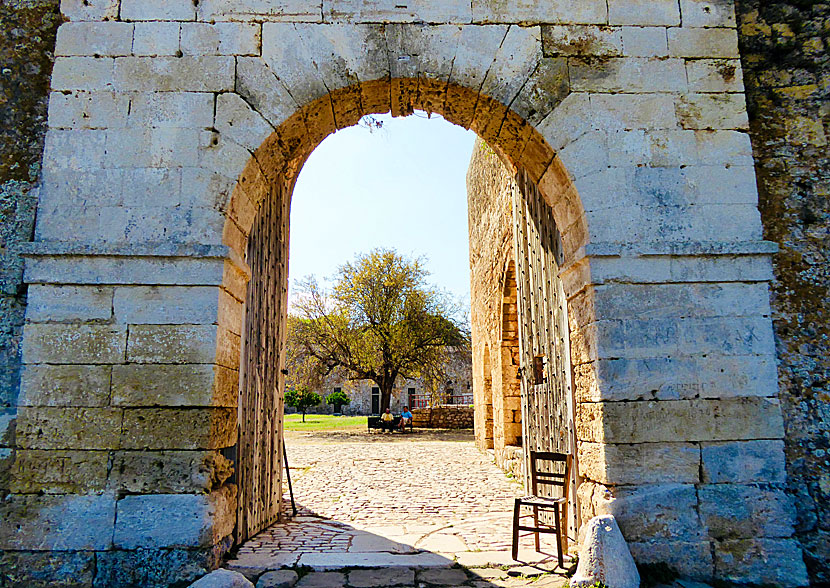
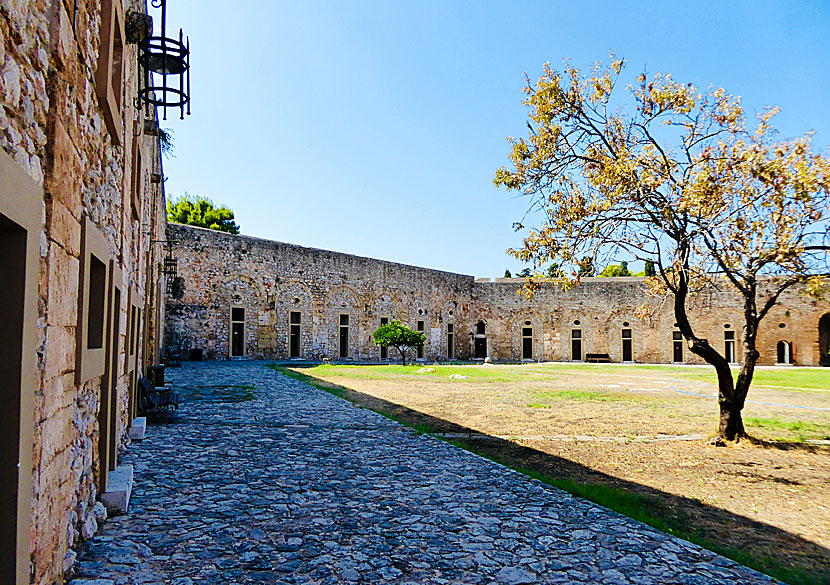
The inner courtyard, or fortress within the fortress if you will, is hexagonal and has massive parapets and projecting bastions that protect five of the six corners of the walls. This is the part of Niokastro that I find most interesting. When you stand in front of the sturdy gate you understand how difficult it was to take Niokastro, yet it was done several times.
The entrance to the massively large and hexagonal inner fortress.
The sturdy gate that is the only entrance to the inner fortress.
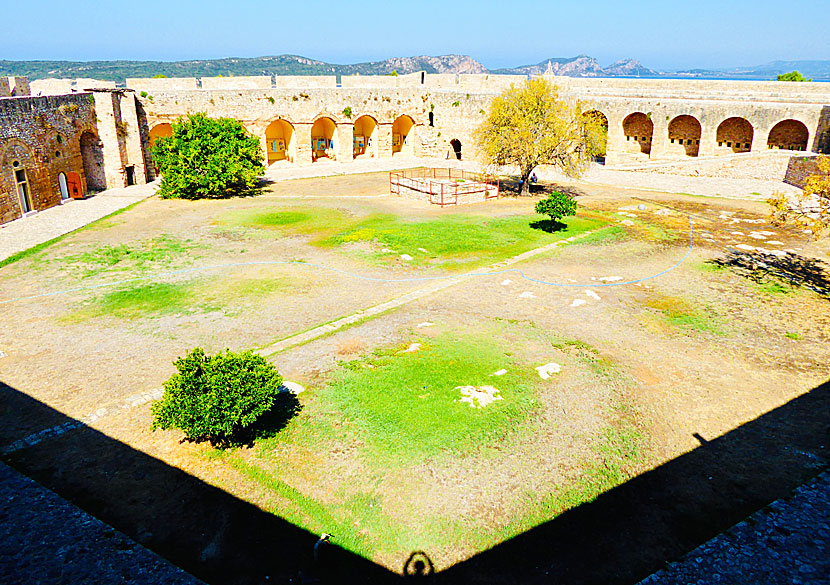
The courtyard of the inner fortress. My shadow is visible in the lower part of the picture. :-) |
|
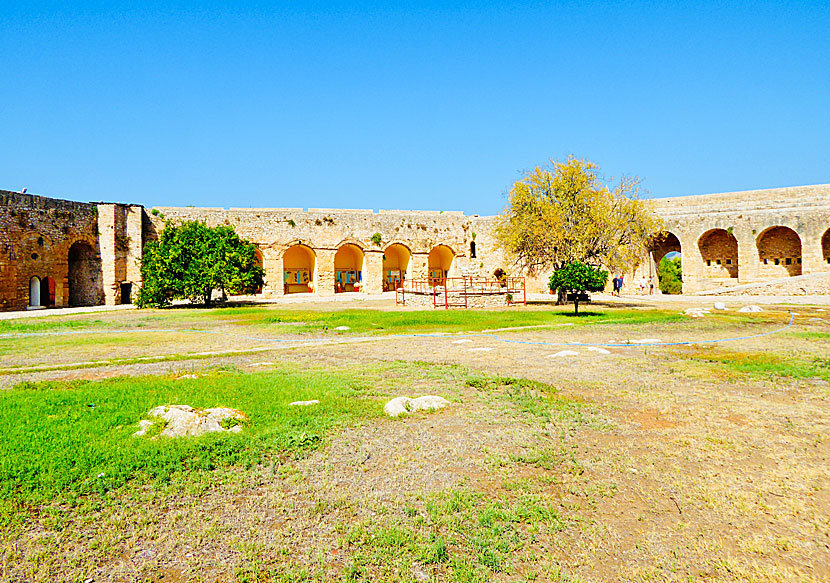
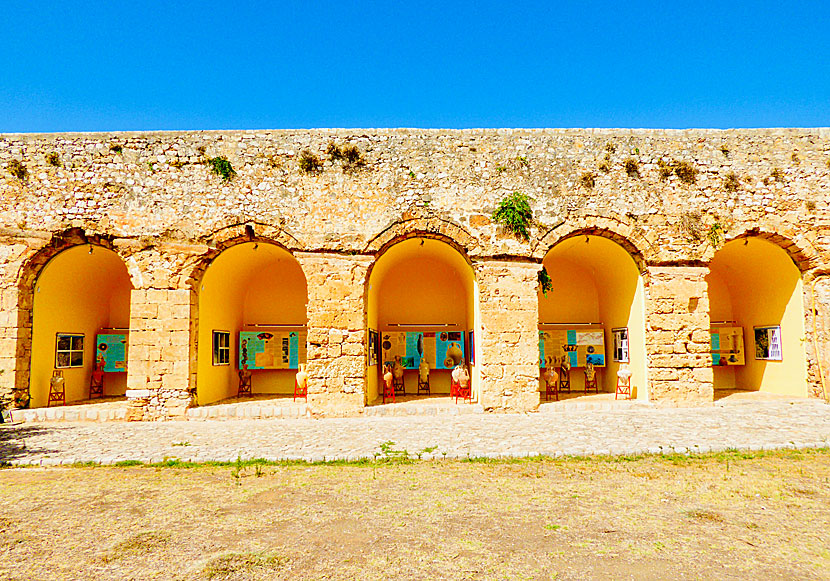
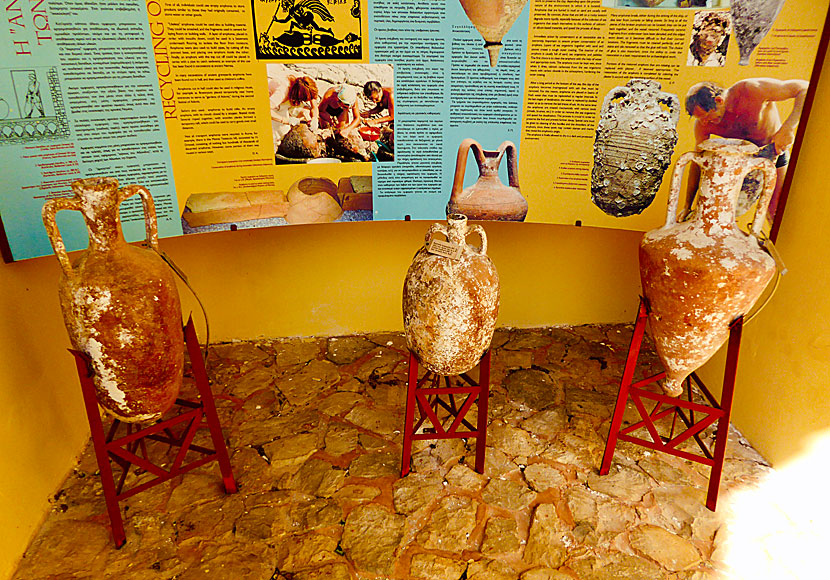
There are no buildings preserved in the inner courtyard, but there is a small museum in one of the defensive walls. It displays finds from shipwrecks in the area, including many amphorae. Information signs telling about the various finds are in Greek and English.
There are no buildings preserved in the inner courtyard.
Part of the museum exhibitions in one of the defensive walls.
Some of the many amphorae found in Navarino Bay.
Is Niokastro worth visiting? Yes, I think so. But that may be because I am a bit overly interested in old Greek fortresses. Visiting Niokastro is like stepping into a room where past and present meet. It is easy to feel the wings of history, and with a little imagination you can perceive the smell of gunpowder smoke and the roar of cannons. Niokastro is no longer a place for battle – rather a place for reflection and curiosity. After a few hours of contemplation, you can go down to the square in Pylos, order a cold beer, and reflect on times gone by.
Niokastro is said to be one of the best preserved fortresses in all of Greece.
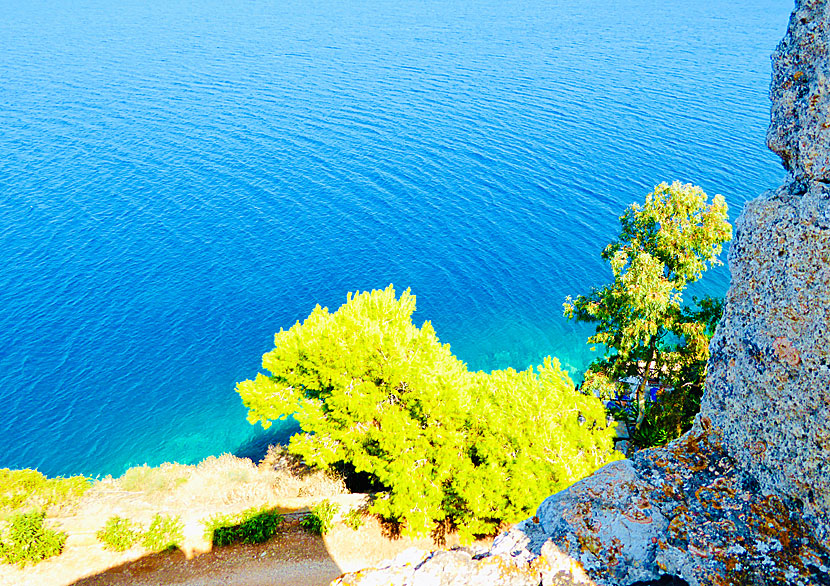
It's not possible to swim below Niokastro, but you'll be very tempted to do so. :-) |
|
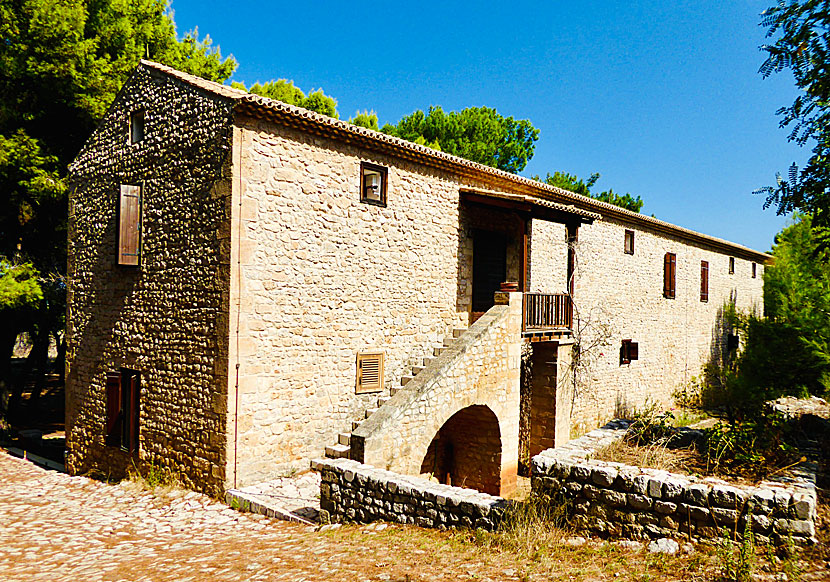
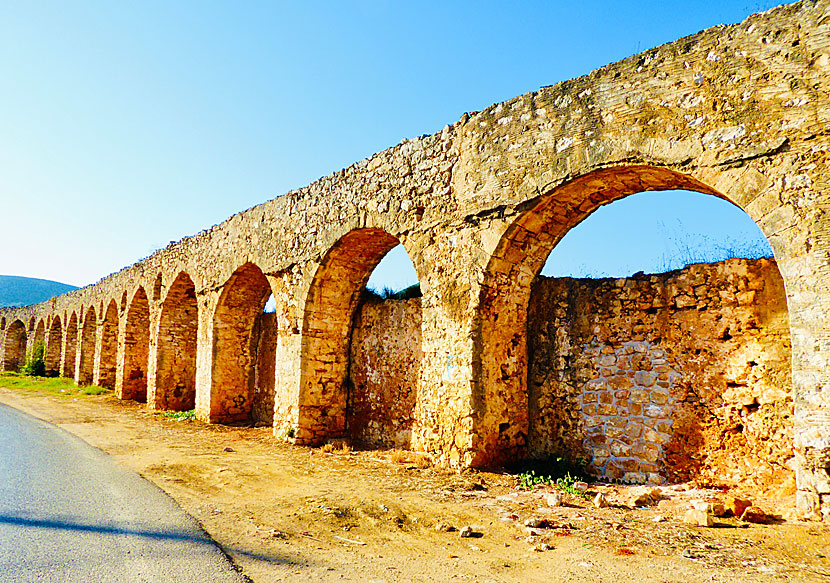
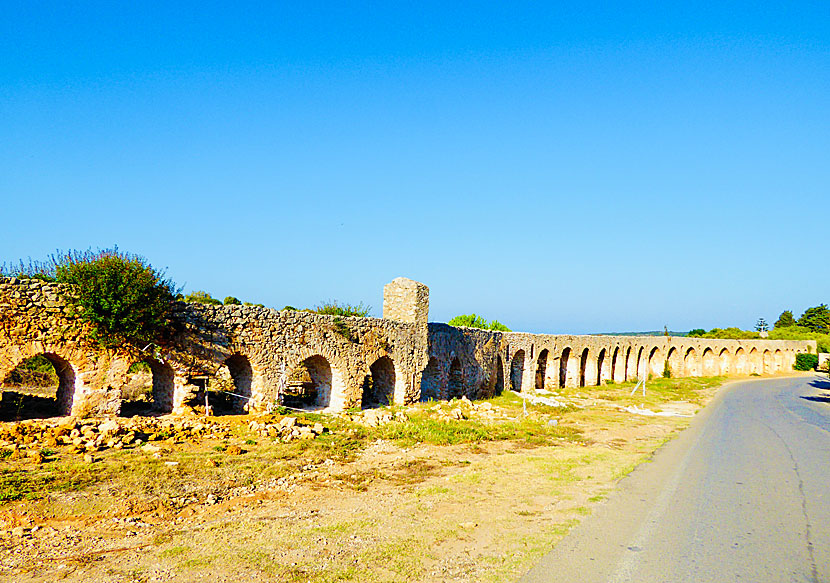
Southeast of Niokastro, along the road to Methoni, Finikounda and Koroni, is an impressive aqueduct, believed to have been built around the same time as the fortress. The aqueduct supplied water to Niokastro and was used to supply water to Pylos until 1907, when Pylos was endowed with a modern water supply.
Part of the impressive aqueduct located along the road to Methoni, Finikounda and Koroni.
The aqueduct supplied water to Niokastro and was used to supply water to Pylos until 1907. |
WHAT YOU SHOULD NOT MISS IF YOU LIKE OLD FORTRESSES
|
HOME |
ABOUT US |
SEARCH |
BOOK HOTEL |
GREEK ISLANDS |
SWEDISH
|
|
© 2007-2026 | Janne Eklund | Kalispera and Kalimera. |